
The Hotspur & Homildon Story
A working plan, but as this is a research project, ideas may change due to conclusions drawn from new information or discoveries.
There is a supposed Great Chinese Curse – ‘May you live in interesting times’. The years covered by this project were most certainly ‘interesting times’ in England and Scotland. Disorder on both sides of the Border was largely brought about by weak leadership of reigning monarchs and destructive rebellions by members of the nobility.
These were the years that inspired William Shakespeare’s history plays of the reigns of Richard II, Henry IV, Henry V, all leading to the fractured and destructive reign of the tragic Henry VI.
The National Situation at the turn of the 1300/ 1400s
At the start of our period of study both England and Scotland were still suffering from the effects of the Black Death of 1350 which killed about 50% of the population. Those remaining could demand sky high wages, but agricultural production was ruined, starvation and famine threatened and consequently the whole economy collapsed into turmoil. The turn of the century saw the approach of the latter stages of the 100 Years War between England and France. Scotland and France were partners under the ‘Auld Alliance’ treaty thus making England’s northern border prone to frequent attacks during conflict on the Continent. These years also set the conditions for the later Wars of the Roses and left the Borders ripe for the continuing ravages of the Border Reivers who continued to lay waste to the land and destroy the economic viability of the Borders until the Union of the Crowns in 1603 under James VI & I.
The following are notes on topics that require much deeper research to link people to events and explain how they had important both local and far-reaching consequences. It should be noted that there are very few certainties in medieval history often due to different perceptions of confrontations held north or south of the Border. This applies particularly to accounts of local Border incidents that were not written until many years after the event took place.
England
Richard II, the last Plantagenet king reigned 1377 - 1399 weak and avaricious leadership. 1399 -Death of John of Gaunt, whose vast wealth was coveted by the King, and banishment of his son Henry Bolinbroke who later that year returned to usurp the throne as the first Lancastrian King Henry IV, and murder Richard II by starvation at Pontefract Castle.,
Scotland
Start of the Steward dynasty, Robert II, Robert III kicked by a horse and left an ineffective ruler. His brothers largely took over but Robert III continued to interfere in national governance to bad effect. Later James I continued to cause dissention among the Scottish lords.
Complicated, brittle and shifting allegiances, raids North and South of the Border, lack of firm and consistent leadership from both N and S, left the Border area in a lawless state and ripe for the Reiving surnames to prosper.
Note: Although Berwick on Tweed had famously been undecided on which side of the Border it should lie, the town and the castle were firmly in English possession from 1384 when it was brought from the Scots for the sum of 2000 marks (about £1340). It was subsequently handed to the Scots in 1461 by Margaret of Anjou, then wife of the incapacitated Henry VI in exchange for help against the Yorkists during the Wars of the Roses.
Unrest in England
Richard II became King at age of 10,- Regency by uncles and later the Lords Appellant.1389 Richard gained control. Raid by Earl of Douglas as far south as Newcastle in 1388 leading to Battle of Otterburn Remaining popular support for Richard II, but Henry IV in 1399 became by force the first Lancastrian king, circumventing more rational claims to the English throne. Roger Mortimer was heir presumptive to Richard II, this claim passed to his son Edmund but in 1399 Henry IV usurped the throne to prevent this succession
Henry Percy appointed Earl of Northumberland on the coronation of Richard II, but later supported the accession of Henry IV. In 1400 rebellion in Wales by Owen Glyndwr and conflict on the Welsh Marches. 1403 Percy rebellion against Henry IV
Unrest in Scotland
1346 David II captured at Battle of Neville’s Cross and held for 11 years. Scotland governed by Robert Stewart. 1357 Treaty of Berwick. - end of 2nd War of Independence
1371 David II died childless, succession passed to nephew, Robert II first of the Stewarts. English enclaves within Scotland including Berwick and Roxburgh. Continuing attacks and invasions from both sides. 1388 Scottish win the Battle of Otterburn, George Dunbar, Earl of March takes over command of the Scottish army when the Earl of Douglas is killed. Hotspur and brother Ralph taken prisoner
Lawless situation in the North.
1390 Robert II died and Robert III becomes king. 1n 1362 had rebelled against David II, but later gained Earldoms of Atholl and Garrick. 1388 suffered a severe injury from a kick from a horse – regarded as unfit to rule and government of Scotland dominated by his younger brother, The Duke of Albany. 1399 the Scottish Parliament condemned his misrule, but he continued to act as he pleased.
Dunbar /Douglas feud
In 1395 Dunbar’s daughter betrothed to Robert III’s son David, but in 1397 this was contested by 3rd Earl of Douglas, the marriage was annulled and Douglas’ own daughter married the heir to the Scottish throne. Dunbar took this as a grave insult, renounced all allegiance to the Scottish King and allied himself and his followers to the court of Henry IV of England. A lasting and bitter feud with the Douglas Clan ensued.
Harry Hotspur’s four linked battles
Much more research is needed in this part of the project. There are many and varied accounts of the following battles. None were written the time, and many of those that we have are biassed, unlikely or simply impossible. This largely why we are doing this project.
Otterburn 1388
Hotspur lost his pennant to Douglas in a personal scrap outside Newcastle, and due to his reckless impatience he chased the retreating Scots as far as Otterburn. Hotspur’s refusal to wait for reinforcements from one of the ‘Fighting Bishops of Durham’ lost him the battle. Douglas was killed, but Dunbar took command over and won a famous Scottish victory, Hotspur and his brother Ralph captured and later ransomed.
Nesbit Moor 1402
Scottish raid ambushed as it returned home. Hotspur and Dunbar (having changed sides) win
Homildon Hill 1402
Larger Scottish raid caught at Wooler. Hotspur and Dunbar victors.
Shrewsbury 1403
Rebellion against Henry IV. Dunbar on English side, Douglas with Hotspur in rebellion against Henry IV.
There were other conflicts of the time including:
Pilleth 1402 on the Welsh Border, and Bramham Moor 1402 in Yorkshire which have a historical relevance to the times.
There is also a battle stone to match that of Homildon Hill. This is located just off the Kirknewton road and signifies the Battle of Yeavering, 1415, a repulsed Scottish raid during Henry V’s Agincourt campaign. As can be seen above, there are a large number of primary sources from which we can deduce a comprehensive account of the most significant circumstances and events of the turn of the 14th /15th century, but the detailed story of Hotspur and the associated conflicts is more ambiguous as we have to rely on the local, and often biased, accounts and opinions of the times. This will require a different approach to our research.
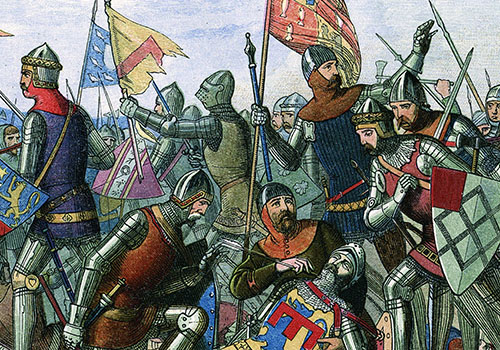
Of the Hotspur battles already mentioned Nesbit Moor and Homildon Hill will be studied in and, if necessary, re-appraised in detail. There are several versions of how the Battle of Homildon Hill was fought, some are feasible, others unlikely or even impossible. We will consider the topography, geology and vegetation of the likely battle site. The weapons and tactics of both sides, and the command and leadership of the combatants will be considered. The range of the longbow is a limiting factor in this battle and will play a large part in our conclusions. As there are no contemporary written accounts of the battle itself, we will veer towards the approach of soldier and military historian Col. A H Burne’s concept of ‘Inherent Military Probability’ for our conclusions. The direct results of this conflict are well documented and will form a major part of this project as they have important national consequences.
Nesbit Moor was a mere skirmish and was considered to have taken place north of the Border, but many historians now consider that a more likely site for the battle is close to Wooler. This will be further investigated as will the series of cross-border insurgencies and rebellions on both sides of the Border.
The Battle of Otterburn has recently been examined in depth by the Battlefields Trust, and we will refer to their conclusions. The Battle of Shrewsbury is outside the territory for this project, but its causes and results are an essential part of the history of Hotspur and must be included.
The situation, personal and political after Homildon Hill is of major importance to the Percy dynasty, and to the whole Border area. In fact the security of the monarchy hung only by a threat and history could easily have been very different. The, the demise, burial, then execution of Harry Hotspur; his later reassembly and the downturn in Percy fortunes and the accession of Hotspur’s son to the Earldom of Northumberland will bring a close to our investigations, but we hope that questions will be raised to continue further work into our Border story.